Stop Hitting Pause on Your High Performance…
There are seasons in life that throw everything off. A major initiative at work. A leadership transition. A travel-heavy quarter. The holidays. Summer with kids in the house and no predictable schedule in sight.
And when those seasons hit, most high performers do something counterproductive — they go from everything to nothing.
If I can't do it right, I won't do it at all.
I used to do this too. A disrupted routine would derail me completely, and I'd tell myself I'd get back on track once things calmed down. But things never really calmed down. They just shifted into the next season of chaos.
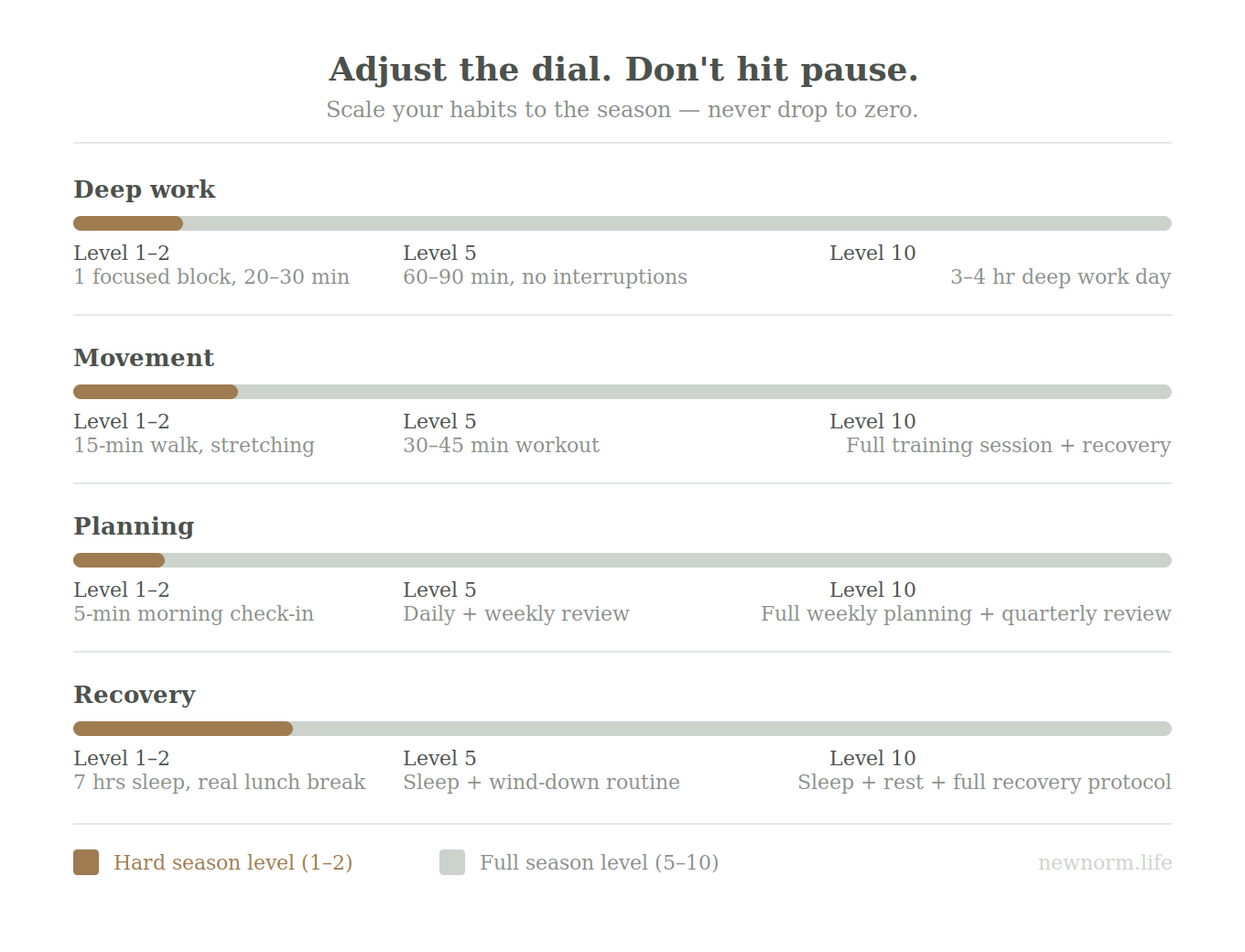
Then I learned a reframe that changed everything: adjust the dial, don't hit pause.
What adjusting the dial actually means
The idea is simple. Instead of treating your high performance habits as all-or-nothing, you scale them to match your current bandwidth. You don't abandon them — you dial them down to what's actually sustainable right now.
Maybe that means your deep work block shrinks from two hours to thirty minutes. Maybe your workout goes from an hour at the gym to a 20-minute walk. Maybe your weekly planning session becomes a five-minute morning check-in. Maybe it just means protecting one non-negotiable — sleep, movement, a real lunch break — when everything else is in flux.
It doesn't feel like enough. That's the point where most people stop.
But here's what I've learned: the people who keep performing at a high level through difficult seasons aren't the ones who push harder. They're the ones who stay in the game.
Momentum is the asset. Consistency — even imperfect, dialed-down consistency — protects it.
The all-or-nothing trap is a performance problem, not a motivation problem
High achievers are particularly vulnerable to this because their standards are genuinely high. A 20-minute walk doesn't feel like a workout. A five-minute check-in doesn't feel like planning. A 30-minute deep work block feels like a fraction of what you're capable of.
So you tell yourself it's not worth doing if you can't do it properly. And then nothing happens for six weeks, and you spend the seventh week trying to rebuild momentum you didn't have to lose.
The math doesn't work. A level 2 version of your habits, maintained consistently through a hard season, will always outperform a level 10 version that gets abandoned when the season shifts.
What you're actually optimizing for isn't a perfect workout or a perfect planning session. You're optimizing for the identity of someone who doesn't stop — who adapts instead of pauses, who scales instead of quits. That identity is what carries you through the seasons when full output isn't possible, and it's what makes returning to full capacity faster and easier when the season opens back up.
What this looks like in practice
The dial isn't binary. Between your best season and complete abandonment, there are dozens of sustainable options.
If your morning routine usually runs 60 minutes, a chaotic travel week might mean 10 minutes: one page of journaling and a glass of water before the day starts. That's not failure. That's the dial at a 2 — and it keeps the habit alive.
If you normally block two hours of uninterrupted work daily, a week of back-to-back meetings might mean protecting one 30-minute slot in the morning before anyone else is online. Imperfect. Still valuable. Still in the game.
The question to ask in any disrupted season isn't "how do I maintain everything?" It's "what's the minimum viable version of my most important habits that I can actually sustain right now?"
Answer that honestly, protect those things, and let everything else flex.
Don't stop. Adjust.
Whatever season you're in — don't hit pause. Find the version of your habits that fits the current reality and protect that version instead.
The season will shift. When it does, turning the dial back up is far easier than starting from zero.
Learning to sustain high performance through disruption — not just in your best seasons — is one of the most practical things we work on together. Book a strategy session if you want to build that kind of resilience deliberately.